

Not Migrated from China, Not Borrowed from Khmer, No Monolithic "Ancient Khmer"!
Scientific and linguistic evidence to dismantle distorted narratives: the Thai people did not migrate en masse from China, but are indigenous inhabitants of Suvarnabhumi. Shared vocabulary represents a regional heritage, and the stone sanctuary civilization is the product of a multi-ethnic society whose continuity has been best preserved by Thailand.
What is widely believed in popular Cambodian discourse often stems from historical misconceptions, particularly those driven by nationalist ideology and systemic indoctrination—practices largely abandoned in the modern era. Cambodian textbook histories present narratives unlike those of any other nation, standing in direct contradiction to objective realities, vilifying neighboring countries, and instilling historical grievances in children from a young age. As a result, generations grow up exposed to one-sided propaganda designed to foster calculated misunderstandings.
Here are prime examples of long-standing historical misconceptions in Cambodian popular belief, along with empirical and scientific evidence that consistently refutes them:
1. We Were Not "Replaced" by Migrants from China
We are the indigenous inhabitants of Suvarnabhumi who integrated with successive waves of migrating populations. The outdated theory that "the Thai people migrated en masse from southern China" is a concept long discarded by modern Thai scholars. Contemporary genetic (DNA) research and modern archaeology unanimously confirm that the population in this land was never completely replaced by a new ethnic group. Rather, we are the "indigenous people of Suvarnabhumi" sharing ancestral roots with Mon-Khmer, Lua, and Khmu ethnolinguistic groups, blended over time with Tai-Kadai speaking populations who gradually moved southward from southern China and assimilated into what constitutes modern Thais.
Distinguishing the Ancient "Great Migration" from Later Maritime Chinese Immigration: A major point of confusion arises from conflating distinct historical eras. A clear distinction must be made between the ancient "Great Migration" of Tai-Kadai speakers—who gradually integrated with the indigenous inhabitants of Suvarnabhumi—and the much later (18th–20th century) maritime immigration of Han Chinese arriving with "a pillow and a mat" (เสื่อผืนหมอนใบ). This late-era Chinese migration occurred across the entire region, including Thailand, Cambodia, Vietnam, Malaysia, and Indonesia. Conflating modern junk-boat Chinese immigration with ancient population movements to claim that "Thais only recently migrated from China" is a shallow mixing of completely different historical epochs.
Actual Population Movements and Genetic Evidence: Large-scale mitochondrial DNA (mtDNA) studies (Kutanan, Stoneking, et al.) tested and compared genetic models, discovering that the data best supports a model where Tai-Kadai-speaking groups migrated southward and extensively intermingled and intermarried with the pre-existing Austroasiatic population, rather than an extreme scenario of genocide or complete population replacement.
Evidence of Ancient Inhabitation on Thai Soil: Proof of long-standing human settlement in Thailand is robust and scientifically verified. For instance, the Ban Non Wat archaeological site in Nakhon Ratchasima Province (a study published in PNAS in 2022 confirmed it as the site of the world's oldest domestic chicken remains, dating back to approximately 1,650–1,250 BCE), alongside sites such as Ban Chiang and Non Nok Tha, demonstrates continuous human settlement for thousands of years prior to the emergence of any modern nation-state in the region.
Portrayals in Cambodian Textbooks and the Shaping of Extremist Hate Narratives: Cambodian textbooks do indeed portray Thais as "barbarians migrating down from southern China" (as confirmed by research from Assoc. Prof. Dr. Santi Pakdeekham and Assoc. Prof. Chanchai Khongpiantham analyzing Cambodian primary and secondary school textbooks). This often leads to the sweeping conclusion that "The Siem (Siamese) migrated from China, had nothing of their own, and stole all of Khmer culture and civilization."
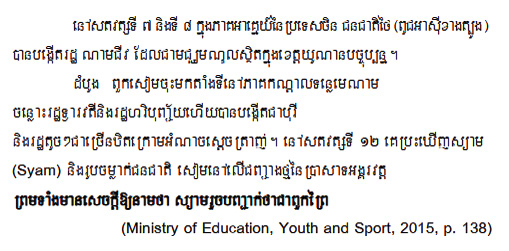
Cambodian textbook stating Thais (Siamese) were barbarians
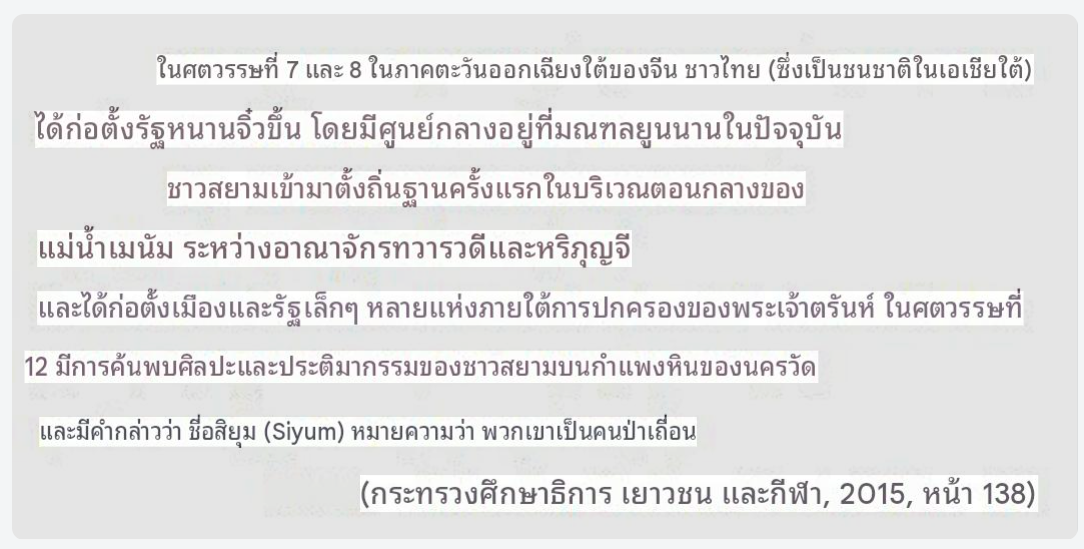
Cambodian textbook stating Thais (Siamese) were barbarians (Thai translation)
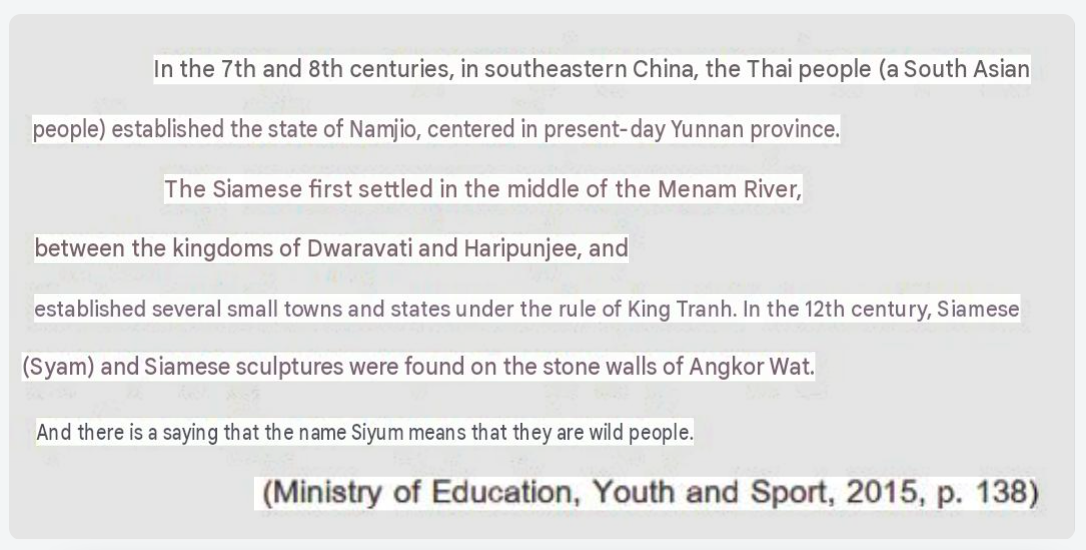
Cambodian textbook stating Thais (Siamese) were barbarians (English translation)
Constructing such frameworks is a textbook example of instilling extreme ethnic nationalism through state educational curricula. It recycles the "Migration from Nanzhao/Yunnan" theory—which was actually an outdated theory from Thailand's own nationalist era (during the regime of Field Marshal Phibunsongkhram and Luang Wichitwathakan). While Thai academia discarded this theory long ago in light of modern DNA and archaeological findings, Cambodia continues to perpetuate this obsolete narrative. They use it to claim that Thailand lacks its own civilization, fostering negative collective memory and embedding deeply rooted misunderstandings among their population.
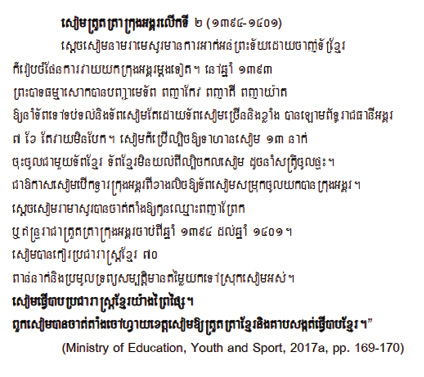
Cambodian textbook defaming Siam
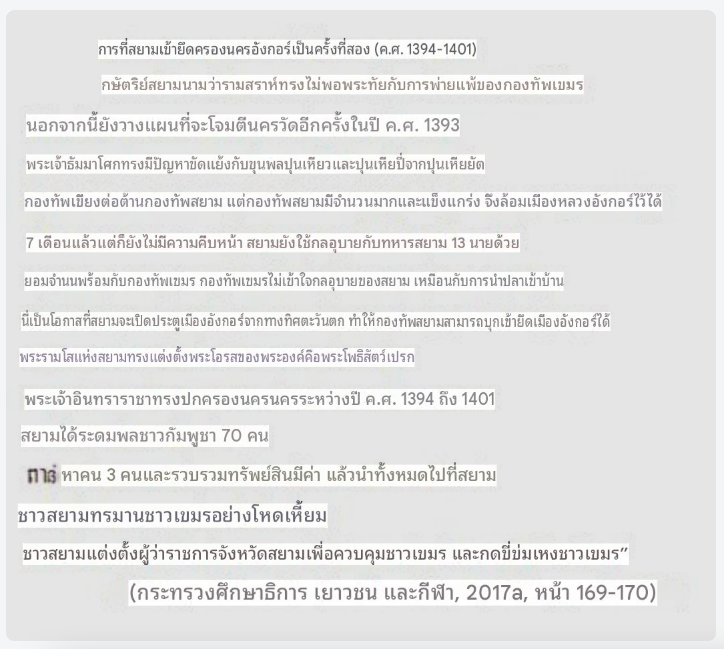
Cambodian textbook defaming Siam (Thai translation)
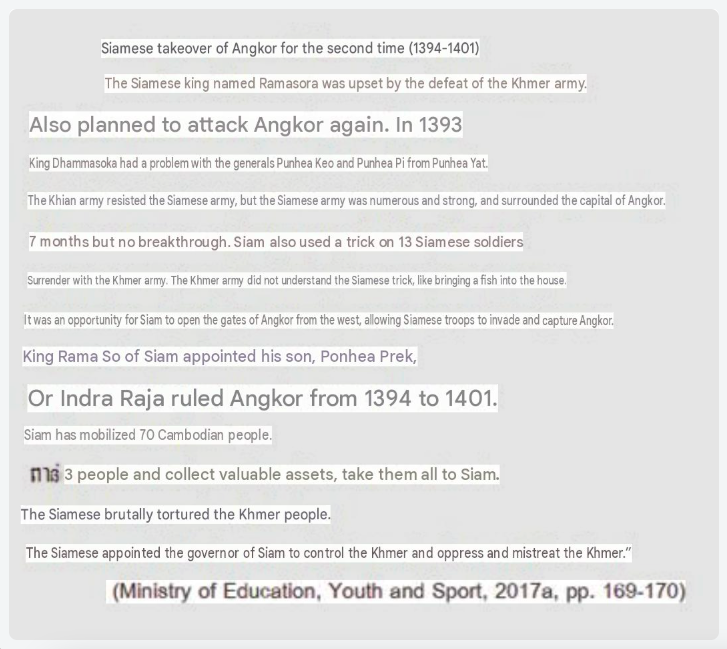
Cambodian textbook defaming Siam (English translation)
Summary: The Thai people are not rootless migrants who displaced others or stole anyone's civilization. They are the product of synthesis between the indigenous roots of Suvarnabhumi and waves of Tai-Kadai speakers. Claims that Thais are "barbarians from China with nothing of their own" are merely propaganda built upon obsolete theories, completely contradicting modern scientific evidence.
2. Distinguishing the "Ancient Empire" from the "Modern Nation-State"
The Angkorian civilization and stone sanctuary architecture of the past belonged to a multi-ethnic society. In that era, modern national borders did not exist. The population that collectively built this civilization comprised diverse ethnic groups—Tai, Mon, Khmer, Cham, and Lawa—who contributed their labor, craftsmanship, and intellect. Therefore, a modern nation-state like Cambodia, whose current borders were drawn by French colonial powers, cannot claim exclusive ownership over this shared heritage.
Crucially, Cambodia experienced a severe "Cultural Discontinuity" (loss of intellectual heritage), primarily due to the tragic genocide during the Khmer Rouge regime. This tragedy nearly wiped out indigenous scholars, master artisans, craftsmen, and performers, resulting in the catastrophic loss of traditional knowledge and arts.
In contrast, the Thai royal courts (from Ayutthaya to Rattanakosin) continuously inherited, preserved, refined, and documented these royal cultural traditions. This unbroken transmission allowed these traditions to flourish into the refined and living Thai identity seen today.
Consequently, constantly invoking the term "Ancient Khmer" to claim sole ownership is an opportunistic narrative, as it appropriates the heritage of an ancient multi-ethnic society and overlays it exclusively onto a modern nation-state!
This ignores the factual contribution of ancestors living on Thai soil who helped build that civilization. It also overlooks the reality that local traditional knowledge in Cambodia suffered a major rupture, while the land of Thailand nurtured, developed, and kept this valuable cultural heritage alive. Claiming ancient heritage exclusively for oneself while denying the historical role and continuity of ancestors on Thai soil is an unsustainable narrative, both in terms of empirical evidence and historical ethics.
3. "Shared Root Words" Are Not "Modern Khmer Loanwords"
And language exchange was never a one-way street. The simplistic narrative asserting that "Thai borrowed words from Khmer"—ranging from everyday terms like sabai (shawl), chamuk (nose), and thanon (road) to royal vocabulary (Rachasap)—presents a superficial and flawed view of historical linguistics.
Consider basic common sense, such as the word "chamuk" (nose): Humans have inhabited Suvarnabhumi for thousands of years. Is it plausible that our ancestors lived, breathed, and survived on this land for millennia without a word for their own facial features, waiting for a neighbor to emerge centuries later so they could "borrow" the word for nose? That defies logic.
The truth is that many of these terms are "Regional Substrate Words" of Southeast Asia. The biological ancestors of the Thai people—who resided in this land since the eras of Funan, Chenla, Dvaravati, and Sri Canasa—spoke and used these words in daily life for thousands of years before the national boundaries of "Cambodia" or even "Angkor" were drawn. These words are an integral linguistic and cultural heritage of the Thai land, not items borrowed from a modern neighboring dictionary.
Furthermore, regarding *royal vocabulary and high court register (Rachasap)*, although shared terms were transmitted across ancient civilizations, it was the Thai royal courts (Ayutthaya to Rattanakosin) that meticulously organized, refined, and expanded these terms into an ornate, structured, and sophisticated linguistic system. Labeling Thais as mere "borrowers" disregards demographic history and diminishes the creative intellectual contributions of our ancestors.
The reality is that exchange occurred in both directions: Modern Khmer itself contains numerous words borrowed from the Tai-Kadai language family. A clear example is the word "waen ta" (spectacles/glasses), a native Tai word adopted into Khmer as vaen ta (វ៉ែនตา). Other examples span daily life, technology, and administration, such as kradat (paper), kalamang (basin), chalat (clever/smart), and nai (master/chief).
However, the fundamental difference is that "Thais have never felt the need to leverage such details to claim ownership or posture as anyone's master."
A mature civilization with an established intellectual history and secure roots views linguistic and cultural exchange as a natural human phenomenon within a shared region. Only "societies facing identity crises and a lack of cultural anchors" resort to aggressive narratives, pointing fingers at everything around them to claim 'that is mine, this is mine' to overcompensate for historical ruptures and deep-seated insecurities.
4. Linguistics, Tones, and Genetics
Irrefutable Evidence. To evaluate the evolution and origin of a civilization objectively, comparative linguistics and genetic evidence (DNA) offer the most transparent and unbiased answers.
Sophistication of the Tonal System: The Thai language, within the Tai-Kadai family, features a highly complex tonal system where pitch inflections function like musical notes. This tonal variation allows for nuanced expression, poetic melody, and precise semantic distinctions—a feature absent in non-tonal Austroasiatic languages. This demonstrates a distinct linguistic evolution and a long standing of poetic, artistic, and musical refinement.
Genetic Truth (DNA): Modern genetic studies consistently confirm that Thais did not undergo a total demographic migration from southern China. The primary genetic lineage of the Thai population consists of indigenous inhabitants of Suvarnabhumi who have lived on this land for thousands of years. What moved down from the north was the language family and wet-rice agricultural technology, which served as a lingua franca and synthesized with the indigenous population to form the modern Thai people.
When genetic and linguistic evidence clearly demonstrates that the people on Thai soil are indigenous to this region with deep ancestral roots, accusations attempting to demean Thais as "latecoming barbarians lacking civilization who only borrow from others" are revealed as mere rhetoric devoid of scientific credibility.
Conclusion
The Thai civilization we cherish today was not created by "copying" or "borrowing" from any modern nation-state. It is the intellectual legacy, bloodline, and hard work of the indigenous people of Suvarnabhumi on Thai soil, whose royal and classical traditions have been continuously sustained and refined without interruption.
It is time to look past colonial-era historiography and superficial narratives, standing tall to view our roots through the lens of science, critical linguistics, and genuine historical evidence!