

Muay Thai vs. Kun Khmer: The Ring Never Lies
For years, Cambodia has insisted that "Kun Khmer" is the true progenitor of Muay Thai, accompanied by unverified folklore such as "Bokator: the lion-killing martial art." This article examines the facts, tracing Muay Thai's historical roots, the distinctions between Bokator and Kun Khmer, the 2023 SEA Games naming dispute, real-world ring results, and exaggerated claims of international recognition—such as the fake WBC belt affair—all backed by verifiable sources.
Introduction
Amidst the intensifying cultural ownership debates in the region, global attention has focused on disputed claims surrounding Muay Thai—a battle-tested martial art that has dominated the international stage for decades. These claims suggest that Muay Thai was derived from or preceded by a modern revived practice known as Kun Khmer, along with narratives like "lion-slaying combat" that lack historical documentation and practical combat verification.
Historical Foundations of Muay Thai
Muay Thai did not emerge overnight; it was forged through centuries of military engagement and the Thai way of life. It is backed by robust empirical evidence, including historical records, centuries-old traditions of boxing camps and arenas, and a structured evolution of rules that transformed it into a globally recognized sport with a distinct identity.

Muay Thai has pioneered its presence on the global stage for decades
Muay Thai enjoys formal international recognition, sanctioned by major world sports bodies such as the International Olympic Committee (IOC) and supported by its own international federation, with widespread competitions across the globe reflecting its long-established stature.
From Bokator to Kun Khmer: Two Distinct Disciplines
Although often presented together on various stages, Bokator and Kun Khmer are fundamentally different in practice.

Authentic traditional Bokator, which differs significantly from modern reinterpretations
Bokator, as revived by San Kim Sean and demonstrated in widely available footage, features slow, dance-like movements intermixed with animal mimicry—such as frog hops—and light taps rather than full-contact engagement. Overall, it resembles a performing art rather than a combat discipline suitable for actual competition.
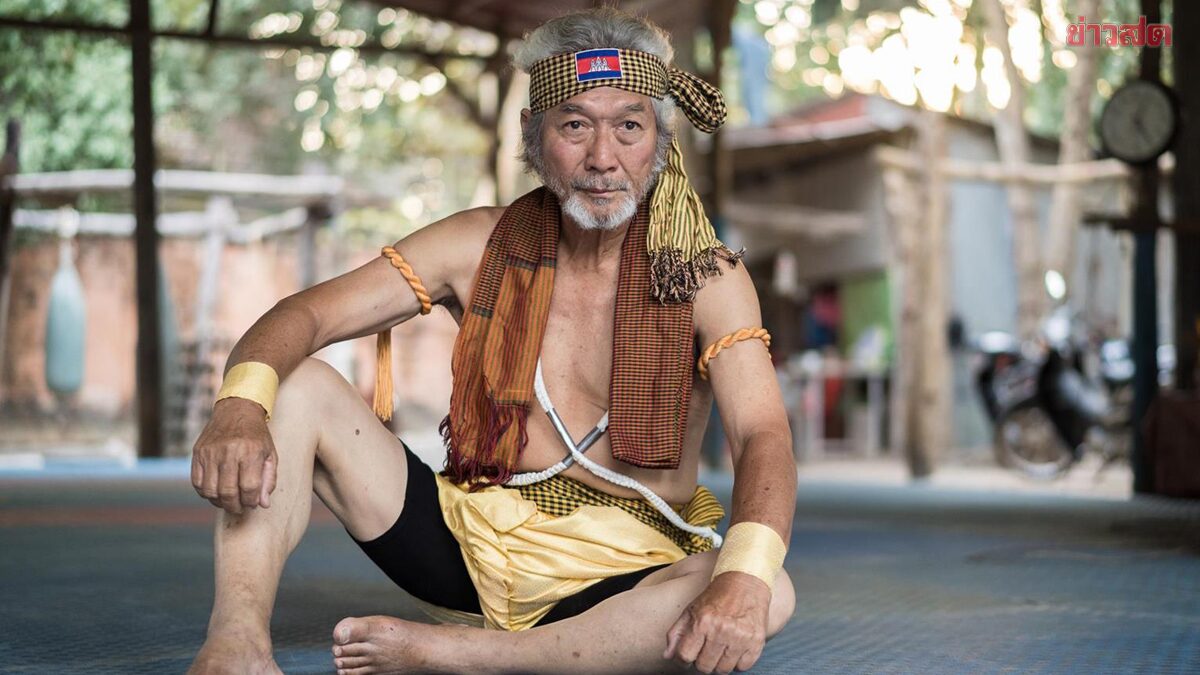
San Kim Sean, Grandmaster of Bokator
In recent years, instructional and promotional videos from Bokator trainers have showcased combat choreography heavily echoing action scenes from Thai movies like Ong-Bak and Tom-Yum-Goong, starring Tony Jaa. This generated lighthearted commentary among Thai social media users, who quipped that without these films as templates, Bokator would primarily consist of frog jumps. Nevertheless, public demonstrations have evolved over time, especially after Bokator was introduced as a sport in the SEA Games, adopting a more standardized athletic routine.
A prominent figure in promoting Bokator's modern image is Pich Charnai, described by Cambodian media outlets such as Khmer Times as an actress and "martial arts star" who vocalizes strong support for Bokator. Clips shared on social media show her being invited to teach fighting stances to military personnel. However, critics and observers—including some Cambodian social media users—note that she has no record of professional combat sports experience, having entered the discipline through acting and influencer roles. This highlights a stark contrast between media persona branding and competitive fighting credentials.
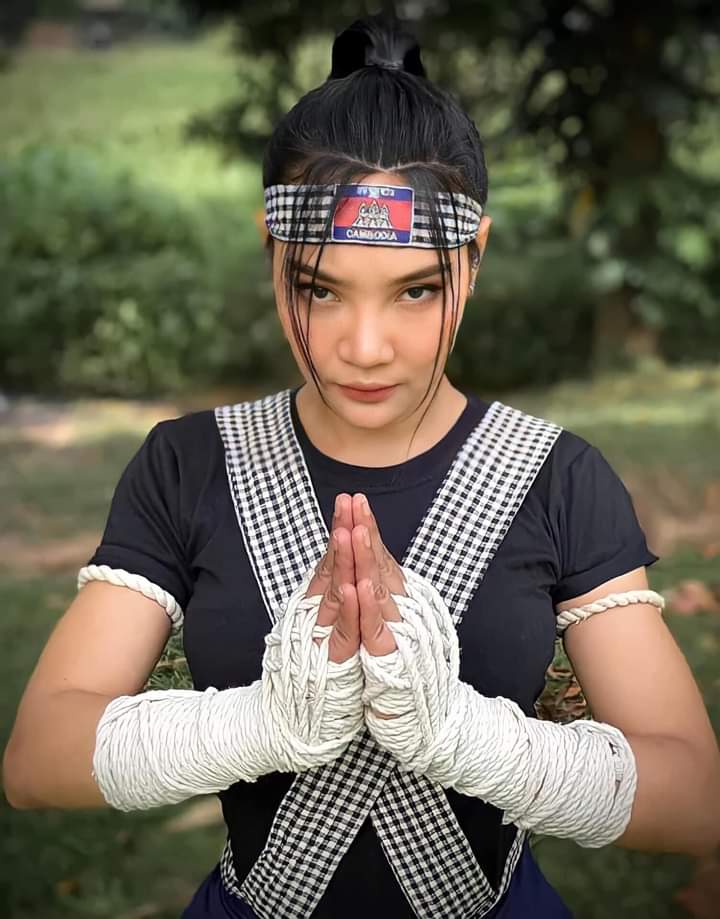
Pich Charnai achieving master status in Bokator primarily through theatrical cinematic postures
The case of Pich Charnai highlights low barriers for recognizing "experts" in modern Bokator, where individuals without professional ring combat experience can gain master-level accreditation and military teaching invitations simply by executing cinematic poses. By contrast, recognized Muay Thai masters must undergo rigorous competitive careers in the ring.
Conversely, Kun Khmer shares striking similarities with Muay Thai across every dimension—including rules, gloves, technique repertoire, and ring mechanics. The term's revival is closely connected to numerous Cambodian fighters who trained and competed in Thailand's Muay Thai circuit for years before returning home due to border tensions to establish themselves as "Kun Khmer" fighters locally.
Questions Regarding Officiating and Fairness
Fight fans and sports media have frequently raised concerns regarding officiating when Thai or international fighters travel to compete in Cambodian Kun Khmer events. Controversial practices—such as intentionally spitting out mouthguards to stall for time when losing, or home-fighter decisions awarded despite clear disadvantages—have recurred in disputed bouts, shaping international perception of Kun Khmer officiating.
The Origins of the "Lion-Killing Martial Art" Myth
One of the most scrutinized assertions is the translation of Bokator as "pounding a lion" (or killing a lion), despite the fact that lions are not native to Southeast Asian geography or zoology. The history and etymology of Bokator currently circulated stem largely from post-Khmer Rouge revival efforts led by San Kim Sean. As such, the lion-slaying narrative appears to be a modern construct intended to confer prestige upon the art rather than a historically grounded ancient tradition.
Another frequent claim asserts that bas-reliefs on Angkor Wat and Angkor Thom walls prove Bokator's origins date to the Angkorian era. However, Angkor Wat was built as a Hindu temple complex with Sanskrit inscriptions, deeply influenced by Brahmin traditions imported from India, which brought their own weapon and hand-to-hand combat systems. Reliefs portraying martial stances, weaponry, or shields reflect Indian influence (such as Kalaripayattu) rather than evidence of a distinct ancient Cambodian martial art named "Bokator"—a term introduced only in recent decades.
Claims of Origin vs. Realities in the Ring
Cambodia has persistently asserted that "Kun Khmer" is the true origin of Muay Thai. This culminated at the 2023 SEA Games hosted in Phnom Penh, where the host organizers replaced the term "Muay Thai" with "Kun Khmer," claiming host-country prerogative. Since the rule set remained virtually identical to Muay Thai, the International Federation of Muaythai Associations (IFMA) withdrew Thai athletes from participation, adhering to IOC recognition of "Muay Thai." (A similar conflict occurred at the 2005 SEA Games in the Philippines, when Cambodia boycotted the debut of Muay Thai as an official medal sport.)
When put to the test in head-to-head competition, however, ring outcomes often contradict these claims. A notable example occurred when 36-year-old Thai veteran Kongjak Por. Pao-in faced Thouey Theara, Cambodia's top-ranked Kun Khmer star. Kongjak defeated Theara via 4th-round TKO due to an arm-breaking roundhouse kick. The decisive outcome sparked widespread dismay among Cambodian fans, directly challenging claims of Kun Khmer superiority.
While bout results between Thai and Cambodian fighters naturally vary with wins and losses on both sides, this back-and-forth reality undermines propaganda portraying Kun Khmer as an inherently superior origin art. If it were truly the dominant original form, such stark defeats against veteran Muay Thai fighters would not occur so decisively.
Exaggerated Claims and Promotional Misrepresentations
Beyond origin claims, several incidents have highlighted misrepresentations intended to bolster credibility. During the 2023 SEA Games debate, promotional graphics featured photographs of former Thai national team Muay Thai trainer Panupong Tanjad labeled as a "Bokator" master, compelling Tanjad to publicly clarify his Thai heritage and Muay Thai background. Around the same time, claims surfaced asserting legendary Muay Thai champion Buakaw Banchamek was of Cambodian descent; Buakaw personally refuted these claims, clarifying that he is ethnically Kouy and a proud Thai national.
Another incident unfolded in April 2025, when Srey Chanthorn, Honorary Vice President of the Khmer Boxing Federation, held a parade showcasing a "WBC Kun Khmer" belt and publicly announced that the World Boxing Council (WBC) had officially recognized Kun Khmer. This led WBC Asia to issue a formal clarification: the belt was merely a commemorative gift presented to the Cambodian government during a boxing event, not an official world championship belt or sport sanctioning. WBC reaffirmed that it exclusively recognizes Professional Boxing and Muay Thai. Srey Chanthorn subsequently acknowledged the misunderstanding.
These recurring incidents reflect a pattern where grand claims of international endorsement are presented to the public, only to be refuted upon fact-checking.
Conclusion
Disputes surrounding martial arts origins in Southeast Asia demonstrate that cultural heritage claims cannot be established through public relations or revised narratives alone; they require verifiable historical documentation and ring-proven authenticity. Muay Thai stands firm on its solid historical foundation and global recognition.
---
Related News & Articles
Muay Thai vs. Kun Khmer: Defeat and Fan Reactions — MGR Online
Kun Khmer Fans Dismayed as No.1 Fighter Suffers Broken Arm Against Muay Thai Veteran — Khaosod
Unpacking the Kun Khmer WBC Gift Belt Controversy — MGR Online
WBC Asia Clarifies Stance on Kun Khmer Sanctioning Claims — Thairath
Muay Thai vs. Kun Khmer: Unraveling the Heritage Debate — Main Stand