

Ko Kut Belongs 100% to Thailand: Historical and Legal Facts Confirming Absolute Sovereignty
When imagining an island in eastern Thailand with crystal-clear waters, powdery sand, tranquil beaches, and pristine nature, "Ko Kut" (Koh Kood) in Trat Province undoubtedly ranks among the top destinations in many people's hearts.
However, the gem-like beauty of this island in the Gulf of Thailand and its abundant marine resources have periodically turned Ko Kut into a topic of geopolitical discussion, sparking recurrent public anxiety over neighboring territorial claims.
---
1. Documented Evidence: The Franco-Siamese Treaty of 1907 (B.E. 2449)
Under international law, Thailand's sovereignty over Ko Kut has been indisputably settled since the reign of King Chulalongkorn (King Rama V).
Under the Franco-Siamese Treaty of 1907 (B.E. 2449), Siam ceded territories including Battambang, Siem Reap, and Sisophon in exchange for recovering Trat Province and its coastal islands. Clause 2 of the Boundary Protocol explicitly states:
"The French Government cedes to Siam the territories of Dan Sai and Krat (Trat), along with all the islands situated south of Laem Sing down to Ko Kut, including Ko Kut itself..."
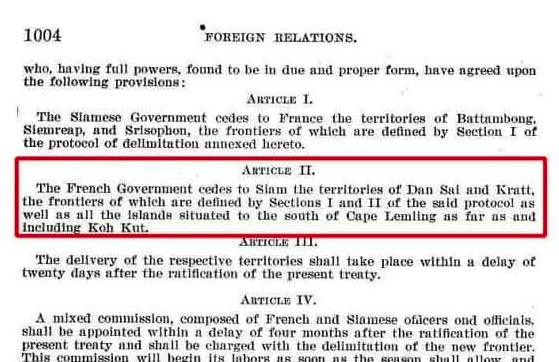
The Franco-Siamese Treaty of 1907, explicitly confirming that Siamese (Thai) territory includes Ko Kut.
When Cambodia gained independence from France, the international boundaries established between France and Siam remained fully in force under the principle of state succession. Consequently, sovereignty over Ko Kut belongs irrevocably to Thailand.
---
2. Unilateral Claim Lines and Thailand's Countermeasure: "The 1973 Royal Proclamation"
While the legal status of the island itself is clear, complexity arose from unilateral maritime declarations.
In 1972 (B.E. 2515), Cambodia unilaterally drew a maritime continental shelf claim line that cut through the middle of Ko Kut. This unilateral line bypassed standard international procedures and disregarded established maritime legal principles.
Just one year later, in 1973 (B.E. 2516), Thailand responded by issuing the Royal Proclamation Establishing the Continental Shelf of the Kingdom of Thailand in the Gulf of Thailand (May 18, 1973), firmly establishing that the waters and continental shelf surrounding Ko Kut legally belong to Thailand under international law.
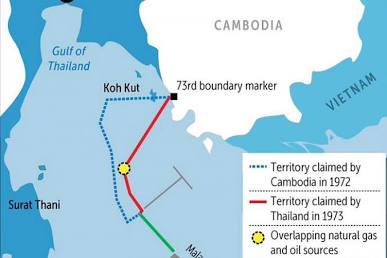
Comparison of maritime claim lines: 1972 (Cambodia) and 1973 (Thailand)
---
3. Ko Kut as a "Baseline" under UNCLOS
According to the United Nations Convention on the Law of the Sea (UNCLOS), Ko Kut is not merely a landmass; Thailand uses Ko Kut as a Straight Baseline reference point to measure its 12-nautical-mile territorial sea and its Exclusive Economic Zone (EEZ) extending south and east.
* Ko Kut has a permanent population, established communities, and a local economy, meeting all criteria under Article 121 of UNCLOS.
Any overlapping claim that disregards the territorial sea rights generated by Ko Kut stands in direct conflict with UNCLOS principles*.
---
4. Disentangling Media Misinformation
Public concern frequently arises when commentary confuses the Overlapping Claims Area (OCA) maritime negotiations with sovereignty over Ko Kut itself.
Key distinctions to remember:
1. Ko Kut Island: Belongs 100% to Thailand, backed by undisputed legal treaties and historical documentation.
2. Overlapping Claims Area (OCA): Refers strictly to maritime shelf claims stemming from Cambodia's 1972 claim line encroaching upon Thailand's baseline, and does not affect land sovereignty over Ko Kut.
Regardless of speculative reports or external claims, Ko Kut remains 100% Thai sovereign territory—a legal fact firmly grounded in international law.